


 2025.09.09
Cable Equipment
With the widespread adoption of artificial intelligence and autonomous driving systems in the automotive industry, the demand for data transmission speeds and computing power driven by large language models and high-speed in-vehicle communications is growing exponentially. According to industry analysis, the global AI server market is projected to reach $158.7 billion by 2025. Within this market, shipments of GB200 server racks are expected to reach 55,000–60,000 units (with each rack’s copper cabling valued at approximately $200,000–$250,000), driving the global AI server copper cabling connector market to a size of $39.5 billion–$57 billion.
In short-range communication scenarios within AI servers and server racks, high-speed copper interconnect technology has become a core solution due to its unique advantages. At the GTC conference on January 3, 2025, NVIDIA explicitly stated that its copper interconnects will remain in use and announced plans to expand the GB300 chip to 224G, further dispelling market concerns about whether PCBs could replace high-speed interconnects. Comparative test results show that the high-speed interconnect performance of copper cables significantly outperforms that of PCBs. The latter suffers from serious issues regarding signal attenuation, ICDR, and crosstalk, making it incapable of replacing copper interconnects. Consequently, NVIDIA has explicitly rejected both the proposal to replace a portion of high-speed interconnects with PCBs and the proposal to replace a portion with optical modules and fiber optics.
Currently, the mainstream data rates for high-speed copper cables are rapidly evolving from 112G to 224G, and are expected to advance further to 448G in the coming years. The resulting increase in transmission loss under these high-bandwidth conditions has become a core bottleneck constraining the development of next-generation high-speed copper cables. To effectively reduce transmission loss, it is necessary to significantly lower the dielectric constant of the insulation layer through foamed insulation technology—which also means that traditional solid insulation structures can no longer meet the stringent requirements of 448G high-speed transmission.
Compared to traditional communication cables, the fluoroplastic extrusion materials used in high-speed copper cables have high melting temperatures and high viscosity, making them difficult to process. Furthermore, the requirements for the extruded products are even more stringent: the outer diameter is generally less than 1 mm, with diameter fluctuations strictly controlled within ±0.002 mm, concentricity exceeding 97%, ellipticity ≤ 0.004 mm, and capacitance deviation precisely controlled within ±0.8 pF. These cable products must simultaneously meet requirements for ultra-fine diameter and excellent foaming, which places extremely stringent demands on the manufacturing capabilities of cable production equipment.
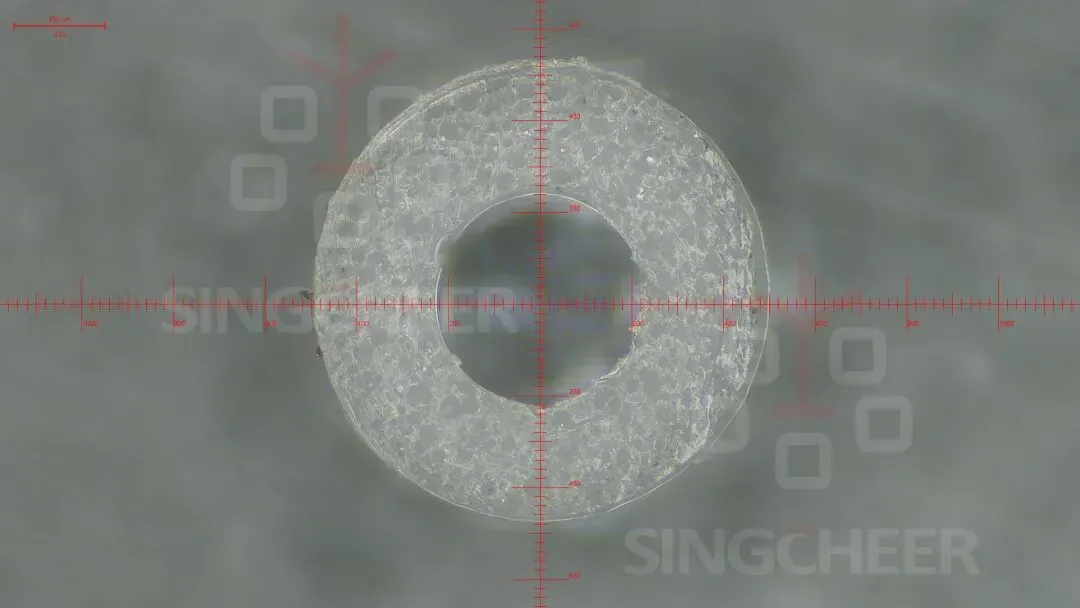
SINGCHEER has overcome numerous technical barriers and challenges, from the selection of materials for the screw and barrel to the optimized design of the nitrogen injection system. After nearly a year of relentless exploration and repeated validation, the company has successfully developed a customized intelligent extrusion production line for physical foaming of fluoroplastics tailored specifically for 448G high-speed copper cables, with a maximum line speed of up to 150 m/min. Equipped with an in-house developed and manufactured extrusion die, this production line ensures fine, uniform foam cell distribution through precise control of nitrogen injection, material flow temperature, and pressure, resulting in core wire performance that meets the industry’s highest standards. The product shown in the video features a conductor diameter of 0.45 mm and a finished outer diameter of 0.99 mm, with an outer diameter tolerance of <±0.004 capacitance="" deviation="" within="" 0.8="" concentricity="">97%, and ovality ≤0.004 mm. The line operates stably at a line speed of 102 m/min. The successful implementation of this production line has not only delivered significant advantages—including a delivery cycle shortened by more than half and substantially reduced costs—but has also provided the digital and intelligent engine needed for the cable industry to rapidly enter the new era of PCIe 8.0 high-bandwidth interconnects.


